ARMA Model — System Identification Walkthrough
This notebook demonstrates the four-step system identification process for a univariate time series using the ARMA model class.
Step |
Task |
Tool |
|---|---|---|
1 |
Choose a model class |
Domain knowledge |
2 |
Select model order |
|
3 |
Estimate parameters |
|
4 |
Validate the model |
|
Dataset: Box-Jenkins Series A — Chemical Concentration (197 observations)
The ARMA(\(n_d\), \(n_c\)) model is
where
and
The noise is modeled by the transfer function \(H(q) = C(q)/D(q)\).
[2]:
import numpy as np
import matplotlib.pyplot as plt
import sys
import os
import pandas as pd

# Add TimeSeries root directory to path
current_dir = os.getcwd()
timeseries_root = os.path.abspath(os.path.join(current_dir, '..', '..', '..'))
if timeseries_root not in sys.path:
    sys.path.insert(0, timeseries_root)

from TimeSeriesSRC.Model.model import pmodel
from TimeSeriesSRC.Model.estimate import estimate
from TimeSeriesSRC.Model.selpmod import func_selpmod as selpmod
from TimeSeriesSRC.basefunctions.uniAnal import func_uniAnal as uniAnal
from TimeSeriesSRC.basefunctions.uniChi import func_uniChi as uniChi
from TimeSeriesSRC.basefunctions.partoacf import func_partoacf_pmod as partoacf_pmod
from TimeSeriesSRC.Model.pmodmse import func_pmodmse as pmodmse
from TimeSeriesSRC.Model.pmoddisp import func_pmoddisp as pmoddisp
from TimeSeriesSRC.Model.pmoddisp import func_pmodpzplot as pmodpzplot

np.random.seed(42)
print('Setup complete.')
Setup complete.
Series A — Chemical Concentration
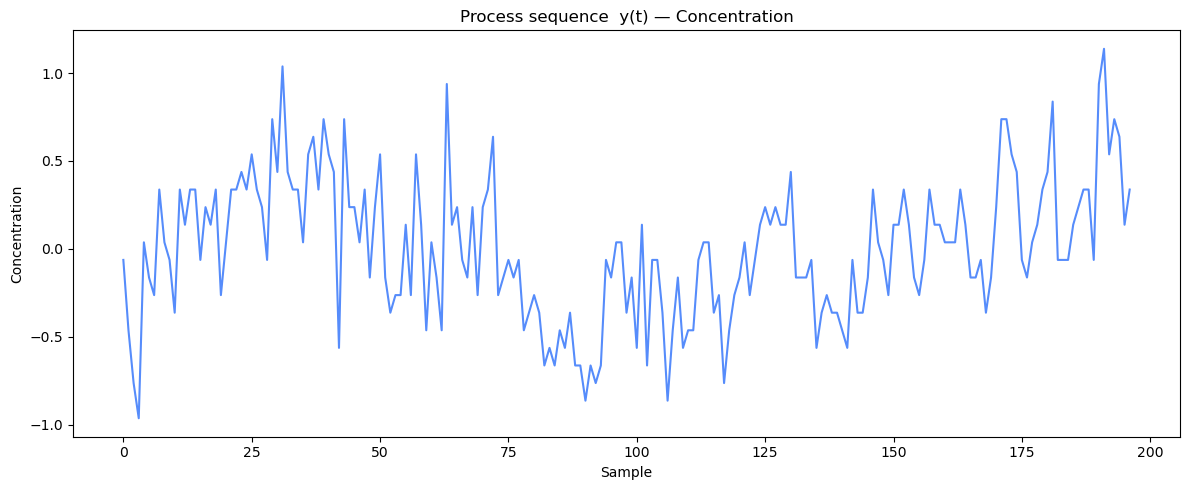
Box-Jenkins Series A is a univariate time series of 197 concentration measurements from a chemical process. There is no observed external input, making the ARMA class the natural starting point. The series mean is removed before modeling.
[3]:
data_path = os.path.join(timeseries_root, 'TimeSeriesSRC', 'TestData', 'Series_A_Chemical_Concentration.csv')
df = pd.read_csv(data_path)
y = np.array(df['Concentration'])
Step 1 — Choose a Model Class
With no external input, the general prediction model \(y(t) = G(q)u(t) + H(q)e(t)\) reduces to a pure noise model:
This is the ARMA(:math:`n_d`, :math:`n_c`) model, where \(D(q)\) is the autoregressive polynomial of order \(n_d\) and \(C(q)\) is the moving average polynomial of order \(n_c\). The orders are determined in Step 2.
[3]:
y = y - np.mean(y)
N = y.size
print(f'Loaded chemical process data: N={N} samples')
print(f'y: mean={y.mean():.2e}, std={y.std():.3f}')

fig, ax = plt.subplots(1, 1, figsize=(12, 5))
ax.plot(y)
ax.set_title('Process sequence  y(t) — Concentration')
ax.set_xlabel('t')
ax.set_ylabel('Concentration')
ax.set_xlabel('Sample')
plt.tight_layout()
plt.show()
Loaded chemical process data: N=197 samples
y: mean=-2.74e-15, std=0.398
Step 2 — Select Model Order
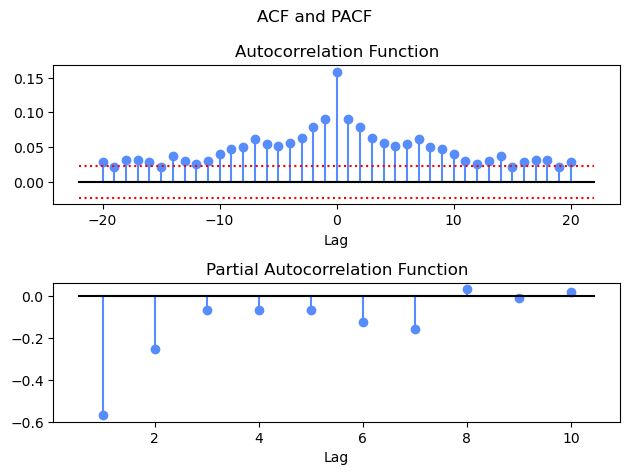
uniAnal computes the ACF, PACF, and Generalized Partial Autocorrelation (GPAC) of the series.
ACF — exponential or oscillatory decay suggests AR behaviour; a sharp cutoff at lag \(n_c\) suggests a pure MA model.
PACF — cuts off sharply after lag \(n_d\) for a pure AR model; decays slowly for a pure MA model.
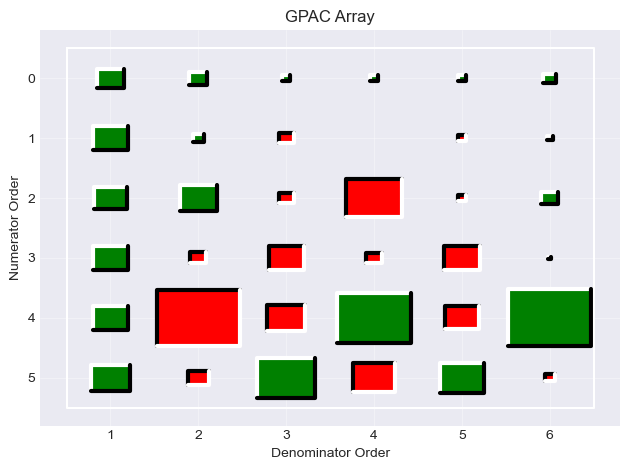
GPAC — the primary tool for ARMA order identification. A column of approximately constant (near-zero) entries identifies the AR order \(n_d\); the row at which the constant pattern begins identifies the MA order \(n_c\).
[4]:
acf, pacf, gpac = uniAnal(y, na=20, nump=10, nrg=6, ncg=6)
GPAC Interpretation
In the GPAC table, look for a column that becomes approximately constant (values near zero from some row onward):
The column index is the candidate AR order \(n_d\).
The row where the constant pattern begins is the candidate MA order \(n_c\).
For Series A, column 1 of the GPAC becomes approximately constant starting at row 1, indicating an ARMA(1, 1) model (\(n_d = 1\), \(n_c = 1\)).
Step 3 — Estimate Parameters
We fit an ARMA(1, 1) model — the structure indicated by the GPAC — using estimate, which minimises the sum of squared one-step prediction errors via the Levenberg–Marquardt algorithm.
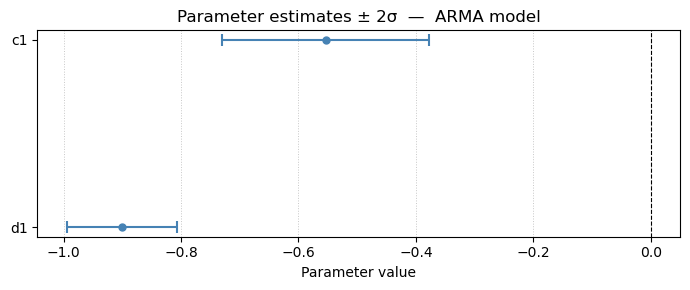
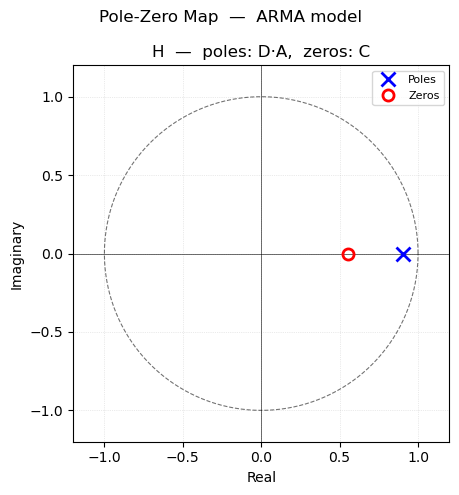
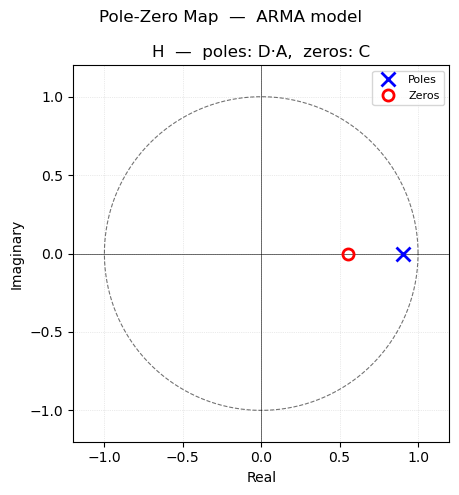
pmoddisp prints the estimated parameters with ±2σ confidence intervals and a confidence-interval plot. pmodpzplot shows the pole-zero map for the noise transfer function \(H(q) = C(q)/D(q)\), confirming stability and invertibility.
[5]:
pmod = pmodel('arma', nc=[1], nd=[1], diff=[0], per=[])
pmod, trec, stat = estimate(pmod, y)
Epoch 0/100 Time 0.0007948875427246094 PMODMSE 0.18876863441748454/0 Gradient 34.47996692994865/0.0001 mu 0.001/10000000000.0
Epoch 10/100 Time 0.1499190330505371 PMODMSE 0.09816324220471359/0 Gradient 0.0028234427030654425/0.0001 mu 1.0000000000000006e-10/10000000000.0
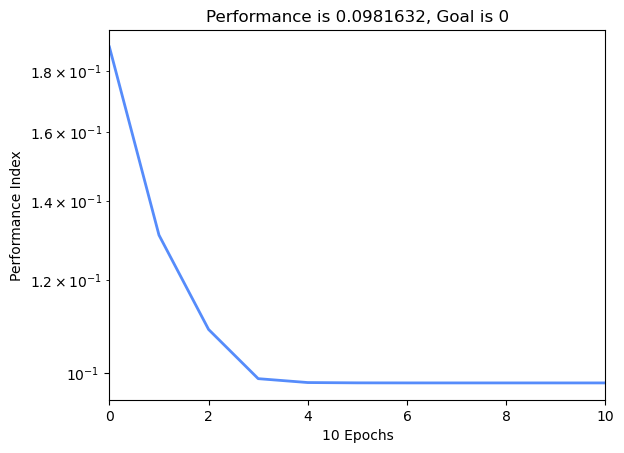
6.114089507982792e-05 0.0001
Epoch 15/100 Time 0.22534489631652832 PMODMSE 0.09816323622692254/0 Gradient 6.114089507982792e-05/0.0001 mu 1.0000000000000009e-15/10000000000.0
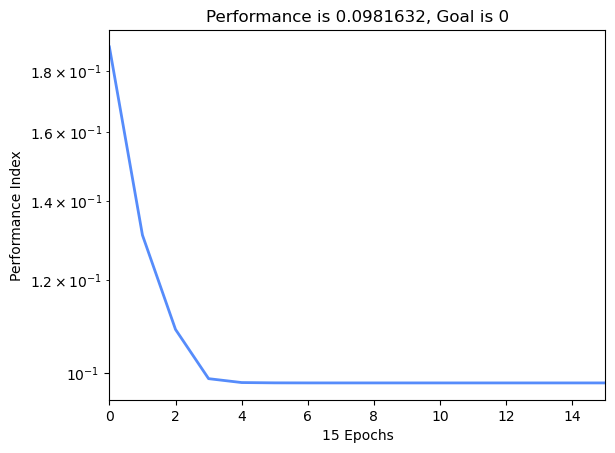
ESTIMLM, Minimum gradient reached, performance goal was not met.
[6]:
pmoddisp(pmod, stat)
pmodpzplot(pmod)
plt.show()
Parameter estimates — ARMA model
--------------------------------
  Param        Value          ±2σ   95% CI
  ----------------------------------------
  c1      -0.5536       0.1762   (   -0.7297,    -0.3774)
  d1      -0.9010       0.0936   (   -0.9946,    -0.8073)

  Residual std  σ = 0.313310
  Residual var  σ² = 0.098163
Step 4 — Validate the Model
A well-fitted ARMA model should leave white residuals — uncorrelated errors with no remaining structure. We check this in three ways:
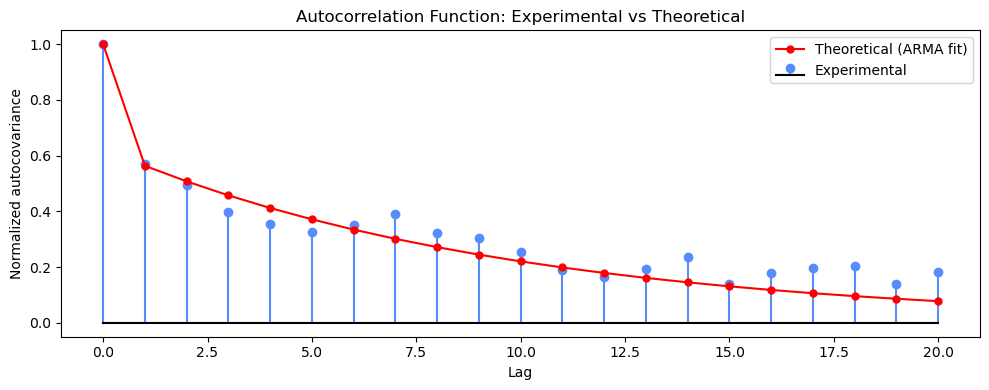
Theoretical ACF —
partoacf_pmodcomputes the theoretical autocovariance function of the fitted model using the Yule-Walker method. Overlaying it on the experimental ACF from Step 2 confirms that the model captures the correlation structure of the data.Residual ACF — plot the ACF, PACF, and GPAC of the residuals with
uniAnal. All values should fall within the 95% confidence bounds (dashed lines).Statistical test —
uniChiperforms the portmanteau chi-square test on the residuals. The null hypothesis is that the residuals are white noise; a p-value > 0.05 indicates an adequate model.
Check 1 — Theoretical vs Experimental ACF
partoacf_pmod uses the Yule-Walker equations to compute the exact autocovariance function implied by the fitted ARMA polynomials and the noise variance. Close agreement with the experimental ACF from Step 2 confirms that the model has captured the dominant correlation structure.
[7]:
# Noise variance estimate from one-step prediction errors
var_e, _ = pmodmse(pmod, y)

# Theoretical autocovariance function from the fitted ARMA(1,1) model
lagmax = 21
acf_theory, _, _ = partoacf_pmod(pmod, var_e, lagmax)

# Experimental ACF from Step 2: uniAnal returned acf of shape (1, 2*na+1)
# with na=20, so index 20 is lag 0; take the positive-lag half
acf_exp = acf.squeeze()[20:20 + lagmax]

# Normalize both to lag-0 = 1 for a shape comparison
acf_theory_norm = acf_theory / acf_theory[0]
acf_exp_norm    = acf_exp    / acf_exp[0]

lags = np.arange(lagmax)

fig, ax = plt.subplots(figsize=(10, 4))
ax.stem(lags, acf_exp_norm, linefmt='C0-', markerfmt='C0o', basefmt='k-', label='Experimental')
ax.plot(lags, acf_theory_norm, 'r-o', markersize=5, linewidth=1.5, label='Theoretical (ARMA fit)')
ax.set_title('Autocorrelation Function: Experimental vs Theoretical')
ax.set_xlabel('Lag')
ax.set_ylabel('Normalized autocovariance')
ax.legend()
plt.tight_layout()
plt.show()
[ ]:
e = y - pmod.predict(y)
print(f'Residual std: {e.std():.4f}')
acf_e, pacf_e, gpac_e = uniAnal(e, na=20, nump=10, nrg=6, ncg=6)
[8]:
#uniChi(pmod, y)

passed, q_arma, n_arma, pval = uniChi(pmod, y)

print(f'\nChi-square test on u residuals:  Q={q_arma:.2f},  df={n_arma},  pass={bool(passed)}, pval={pval:.3f}')
print('(pass=True means residuals are consistent with white noise at 95% confidence)')
pval: 0.1040045634909047
alpha: 0.05
pr: 0.8959954365090953
q: 25.82270352305808

Chi-square test on u residuals:  Q=25.82,  df=18,  pass=True, pval=0.104
(pass=True means residuals are consistent with white noise at 95% confidence)
Conclusion
The residual ACF is within the 95% confidence bounds (approximating an impulse function), the first row of the GPAC is approximately zero (indicating white noise) and the chi-square test is passed (p-value > 0.05), therefore the ARMA(1, 1) model is validated. .
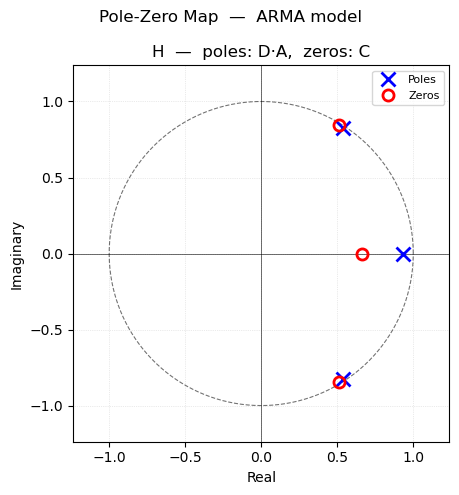
The fitted parameter table from pmoddisp shows the estimated values with ±2σ confidence intervals, and none of the confidence intervals includes zero, which would indicate that a parameter could be removed. The pole-zero map from pmodpzplot confirms whether the AR and MA polynomials are stable and invertible — all poles and zeros should lie outside the unit circle. Also, there is no approximate pole/zero cancellation, which would indicate that the model orders could be reduced.
If the residuals show remaining structure, return to Step 2 and explore higher-order structures, or use selpmod for an automated grid search over ARMA orders.
Automated Model Selection with selpmod
selpmod performs a grid search over a set of candidate ARMA structures, estimating each one and ranking by AIC and BIC. We search over \(n_d \in \{1, 2, 3\}\) and \(n_c \in \{0, 1, 2, 3\}\) — 12 combinations — to verify that the ARMA(1, 1) structure identified in Step 2 is indeed optimal.
[9]:
arma_spec = {
    'models': [{
        'type': 'arma',
        'nc': [0, 1, 2, 3],
        'nd': [1, 2, 3],
        'diff': [0]
    }]
}
result  = selpmod(arma_spec, y)
aicmod  = result['arma']['aicmod']
bicmod  = result['arma']['bicmod']
aicstat = result['arma']['aicstat']
bicstat = result['arma']['bicstat']
Selecting the best ARMA prediction model
arma: Combination 1 out of 12 total  [nc=0, nd=1].  aic = -2.2262, bic = -2.2096
arma: Combination 2 out of 12 total  [nc=0, nd=2].  aic = -2.2818, bic = -2.2485
arma: Combination 3 out of 12 total  [nc=0, nd=3].  aic = -2.2771, bic = -2.2271
arma: Combination 4 out of 12 total  [nc=1, nd=1].  aic = -2.3008, bic = -2.2675
arma: Combination 5 out of 12 total  [nc=1, nd=2].  aic = -2.3013, bic = -2.2513
arma: Combination 6 out of 12 total  [nc=1, nd=3].  aic = -2.2966, bic = -2.2299
arma: Combination 7 out of 12 total  [nc=2, nd=1].  aic = -2.2979, bic = -2.2479
arma: Combination 8 out of 12 total  [nc=2, nd=2].  aic = -2.2818, bic = -2.2151
arma: Combination 9 out of 12 total  [nc=2, nd=3].  aic = -2.2846, bic = -2.2013
arma: Combination 10 out of 12 total  [nc=3, nd=1].  aic = -2.2983, bic = -2.2317
arma: Combination 11 out of 12 total  [nc=3, nd=2].  aic = -2.2809, bic = -2.1975
arma: Combination 12 out of 12 total  [nc=3, nd=3].  aic = -2.3180, bic = -2.2180
[10]:
print(f'Best AIC model: ARMA(nd={int(aicmod.nd[0])}, nc={int(aicmod.nc[0])})')
print(f'Best BIC model: ARMA(nd={int(bicmod.nd[0])}, nc={int(bicmod.nc[0])})\n')

print('=== Best AIC model ===')
pmoddisp(aicmod, aicstat)
pmodpzplot(aicmod)
plt.show()

print('=== Best BIC model ===')
pmoddisp(bicmod, bicstat)
pmodpzplot(bicmod)
plt.show()
Best AIC model: ARMA(nd=3, nc=3)
Best BIC model: ARMA(nd=1, nc=1)

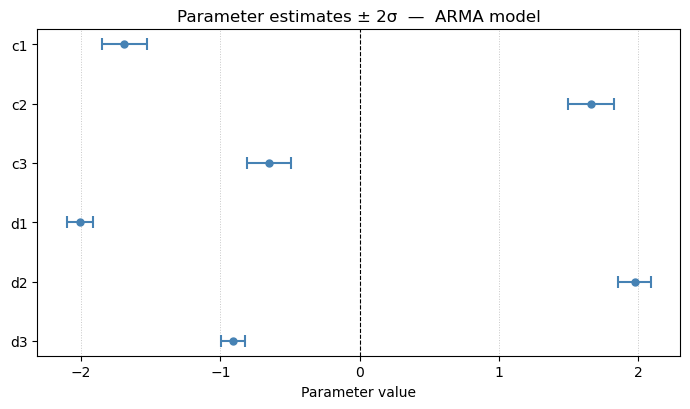
=== Best AIC model ===
Parameter estimates — ARMA model
--------------------------------
  Param        Value          ±2σ   95% CI
  ----------------------------------------
  c1      -1.6897       0.1603   (   -1.8500,    -1.5294)
  c2       1.6609       0.1663   (    1.4946,     1.8271)
  c3      -0.6489       0.1576   (   -0.8065,    -0.4912)
  d1      -2.0100       0.0935   (   -2.1035,    -1.9165)
  d2       1.9745       0.1165   (    1.8580,     2.0910)
  d3      -0.9062       0.0861   (   -0.9923,    -0.8202)

  Residual std  σ = 0.304386
  Residual var  σ² = 0.092651
=== Best BIC model ===
Parameter estimates — ARMA model
--------------------------------
  Param        Value          ±2σ   95% CI
  ----------------------------------------
  c1      -0.5536       0.1762   (   -0.7297,    -0.3774)
  d1      -0.9010       0.0936   (   -0.9946,    -0.8073)

  Residual std  σ = 0.313310
  Residual var  σ² = 0.098163
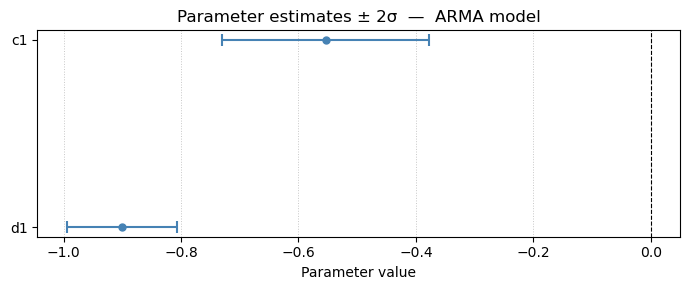
Notice that the best AIC model increased nc and nd by 2. However, when we look at the pole / zero plot, we see that there are pole / zero cancellations. After the cancellation, we revert back to the original model. The best BIC model is the same as the original model we selected from the preliminary analysis.